01 · The detector
What is a hexaboard?
CERN’s Large Hadron Collider is being upgraded to the High-Luminosity LHC (HL-LHC), with many more collisions and therefore far more radiation in the detector. HGCAL is part of how CMS is getting ready.
HGCAL is a sampling calorimeter: dense metal plates make each incoming particle break up into a shower of lower-energy particles, and sensitive layers between the plates sample the energy of that shower. What is new is how finely it samples.
Where radiation is highest, the sensitive layers are made of silicon: about six million cells, each about half a square centimeter or a little over one square centimeter in size, that record the shape of every shower in three dimensions. Silicon also responds fast enough to time its signals precisely, which helps separate the many collisions that happen in each crossing of the proton beams.
The silicon comes as hexagonal sensors, a shape that makes good use of the round wafers they are cut from and covers a surface without gaps. Farther out, where radiation is lower, plastic scintillator tiles are used instead.
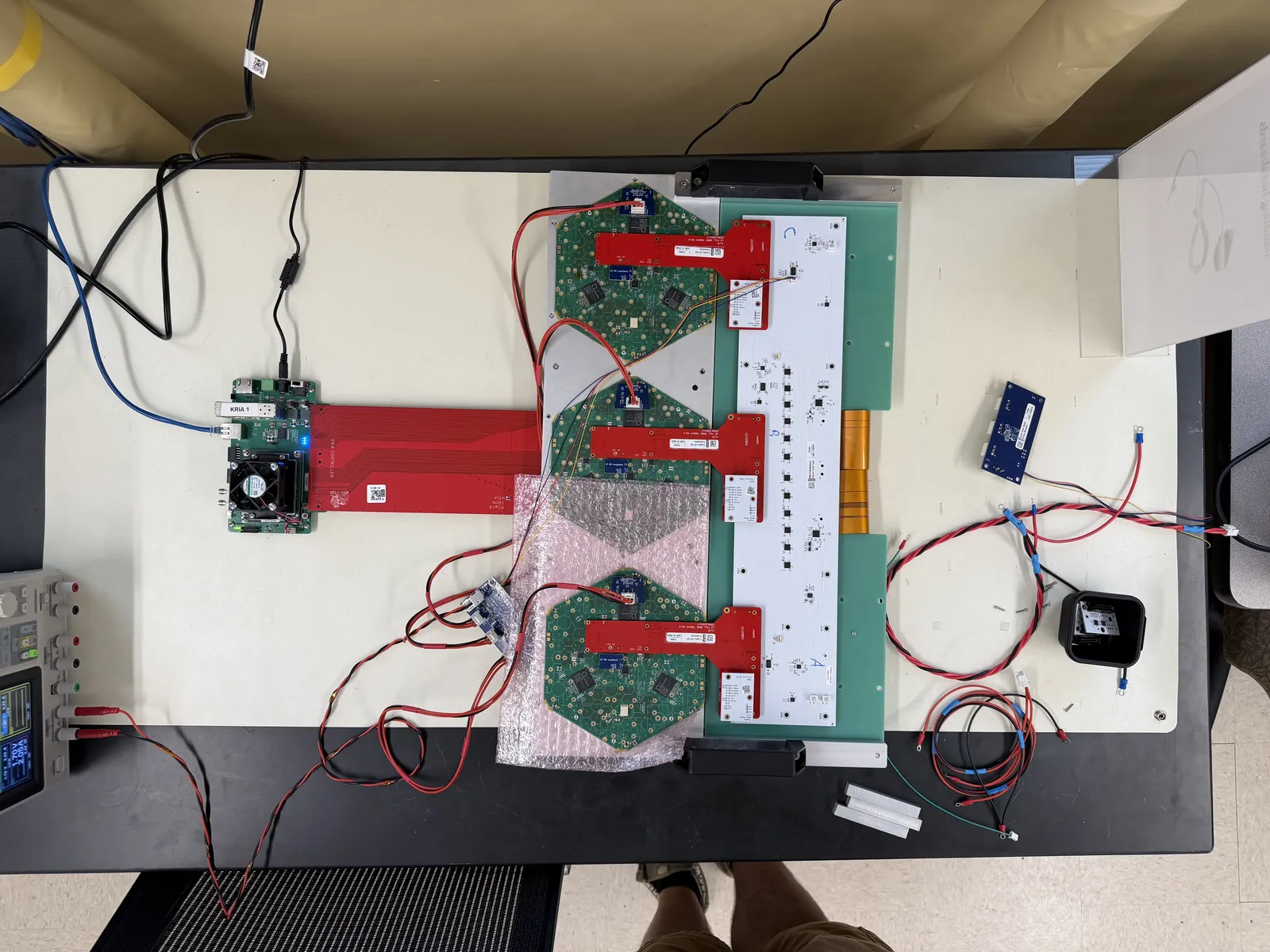
A hexaboard is the hexagonal printed circuit board that turns a bare sensor into a working detector module. It is glued directly on top of the sensor. Holes through the board let fine wire bonds connect the sensor’s cells to the board, and readout chips on the board amplify and digitize the tiny signals, measuring how much energy landed in each cell.
Once a board is glued to its sensor, it stays there, so problems are best caught before that happens. That is where my lab comes in.