Teaching

Teaching physics, a hundred students at a time

At The University of Alabama I teach calculus-based introductory physics to classes of about 100 students, as well as modern physics, classical mechanics and the graduate physics seminar. I also mentor the students in my group and have taught machine learning at CMS training schools.

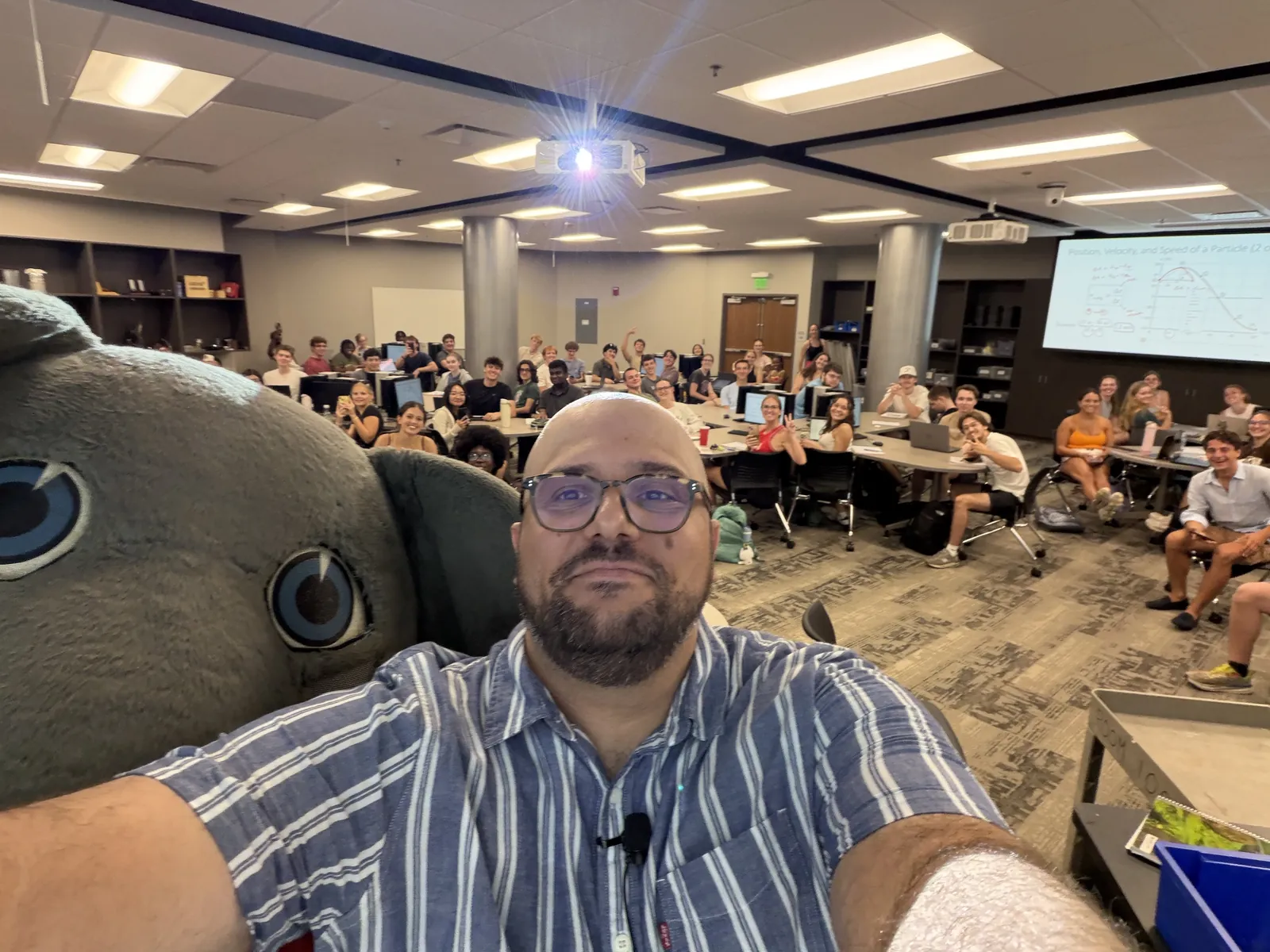
Selfie of Emanuele Usai in front of a large introductory physics class seated at group tables, with the Big Al elephant mascot beside him and a lecture slide on the screen.
One of my introductory physics classes. These sections usually have about 100 students.

Courses

Courses at The University of Alabama

The course I teach most often is PH105, Introduction to Physics with Calculus I, the first semester of the calculus-based introductory sequence. I have taught it in five semesters since Spring 2023, counting the current one (Fall 2026), each time to about 100 students. This semester I am teaching it alongside the second course in the sequence, PH106.

I have also taught Introduction to Modern Physics (PH253) and Intermediate Classical Mechanics (PH302), and since Fall 2025 the Graduate Physics Seminar (PH597). Altogether that is 695 student enrollments in my undergraduate courses since Spring 2023.

Courses I have taught at The University of Alabama, newest first. Enrollment is listed for undergraduate courses.
SemesterCourseLevelEnrollment
Fall 2026PH105 Introduction to Physics with Calculus IUndergraduate100 students
PH106 Introduction to Physics with Calculus IIUndergraduate92 students
PH597 Graduate Physics SeminarGraduate
PH590 Research TechniquesGraduate
Spring 2026PH302 Intermediate Classical MechanicsUndergraduate22 students
PH597 Graduate Physics SeminarGraduate
Fall 2025PH105 Introduction to Physics with Calculus IUndergraduate107 students
PH597 Graduate Physics SeminarGraduate
Fall 2024PH253 Introduction to Modern PhysicsUndergraduate63 students
Spring 2024PH105 Introduction to Physics with Calculus IUndergraduate106 students
Fall 2023PH105 Introduction to Physics with Calculus IUndergraduate105 students
Spring 2023PH105 Introduction to Physics with Calculus I, with an honors section (PH125)Undergraduate89 + 11 students

I also gave a guest lecture on silicon detectors and top quark physics in PH516 (Fall 2023), and since 2024 I have taught PH598, Research, for the graduate students in my group.

Teaching development

Training and feedback

In June 2023 I attended the Faculty Teaching Institute of the American Association of Physics Teachers (AAPT) in Washington, DC.

Every year since 2023, faculty colleagues have observed my classes through peer teaching observations. For every course I teach, I also complete a Student Learning Outcomes assessment, which measures how well the class met the learning goals set for the course.

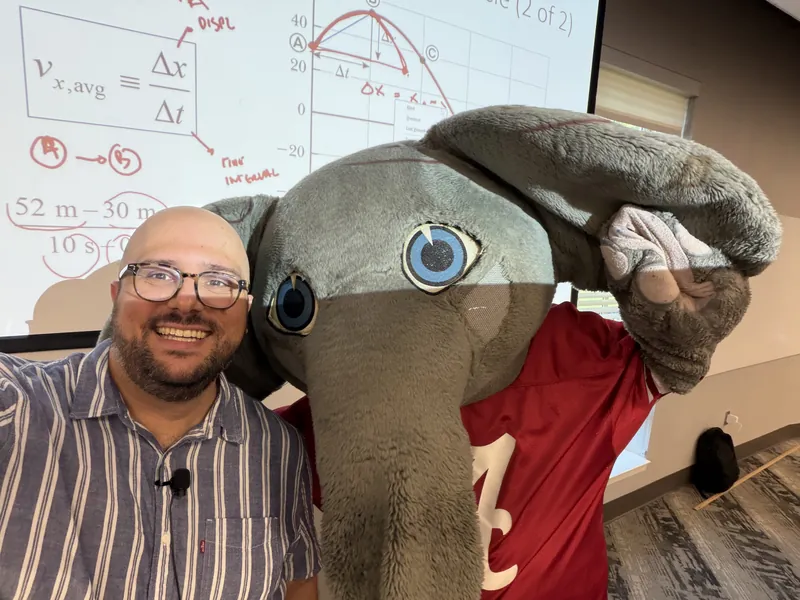
Selfie of Emanuele Usai with the Big Al elephant mascot in front of a lecture slide defining average velocity as the change in position divided by the change in time.
Big Al, the University of Alabama’s mascot, visits intro physics. On the slide: average velocity, Δx/Δt.

Mentoring

Mentoring students in research

I supervise one postdoctoral researcher and, as main advisor, three graduate students, who work on CMS data analysis and on the construction of the CMS High Granularity Calorimeter (HGCAL). Since 2024, five undergraduates have done research in our HGCAL lab, testing and inspecting the hexagonal readout boards (hexaboards) we quality-control for the detector.

1postdoctoral researcher
3graduate students, as main advisor
5undergraduate researchers since 2024
Awards
Nathan Nguyen, an undergraduate researcher in our lab from 2024 to 2026 and now a graduate student in the group, received the 2024 US CMS HL‑LHC Detector Upgrade Essential Contribution Award and the 2026 Randall Outstanding Undergraduate Research Award.
Presentations
Students working in my lab have given talks and presented posters at meetings of the American Physical Society (APS) in 2025 and 2026, and of its Southeastern Section (SESAPS) in 2024 and 2025.
Committees
I chaired two graduate preliminary examination committees in 2025 and served on four in 2023 and 2024, as well as on two yearly-update committees in 2025.
Co-supervision
I co-supervised two graduate research projects, in 2023–2024 and 2024–2025.

Meet the group

Outreach

Teaching beyond the classroom

Outside my courses, I have taught machine learning and data analysis to fellow CMS physicists, co-administered open-source organizations in Google Summer of Code, co-organized machine learning hackathons, and brought machine learning, physics and the LHC to high school students and the public.

2021–2026 · Open-source science

Google Summer of Code

Google Summer of Code pairs new contributors with mentors on open-source projects. I co-administer two of its organizations: Machine Learning for Science (ML4SCI) since 2021 and HumanAI since 2024. In 2021 I coordinated 19 ML4SCI projects applying machine learning to scientific research, including quantum generative models and quantum convolutional neural networks for physics data. That year ML4SCI had 5% of all projects submitted to the program.

2016–2022 · Training CMS physicists

Schools at Fermilab’s LHC Physics Center

At the CMS Data Analysis School at the LPC, which trains collaborators who are starting out in CMS, I was a facilitator in 2016, 2020, 2021 and 2022, on machine learning and on a search for a hypothetical heavy Z′ boson decaying to a top quark and its antiquark. For experienced collaborators, I taught the machine learning course at the LPC Hands-on Advanced Tutorial Sessions (HATS) in June 2020 and 2021.

2018–2021 · Competitions

Machine learning hackathons

I co-organized the 2018 LHC ML Hackathon, a three-day competition in the style of Kaggle, where teams race to build the best model on a shared data set from the Large Hadron Collider, followed by the ML4SCI Hackathons in 2020 and 2021. In 2021 the competition opened to other fields of science and ran for three weeks.

2018–2019 · High school

CS4RI Summits

Computer Science for Rhode Island (CS4RI) brings computer science learning to high school students, with a particular focus on groups underrepresented in STEM. At its summits in December 2018 and December 2019, I prepared and delivered an hour-long lecture on machine learning applied to physics. More than 200 students attended my lectures in total.

2018–2019 · The public

Big Bang Science Fair

An outreach event organized by Brown University’s high-energy physics group, with more than 2,000 attendees. In September 2018 and September 2019 I was an organizer and exhibitor, and coordinated the LHC exhibit.

2023–2026 · At UA

Bringing students into research

I have recruited undergraduate researchers at UA’s Faculty Research Showcase (2023, 2024), and staffed the physics booth at the BCAS Open Day (2026) and the department’s graduate recruitment table at SESAPS (2023, 2025). I also served as a judge at UA’s Undergraduate Research and Creative Activity (URCA) Conference in 2023, 2024 and 2025.

UA undergraduates: try research in the HGCAL lab

If you are a UA undergraduate, in one of my classes or not, you can get involved in research by joining the undergraduates who test and inspect hexaboards in our HGCAL lab. Here is how to start.