Undergraduates
Test detector boards for CMS
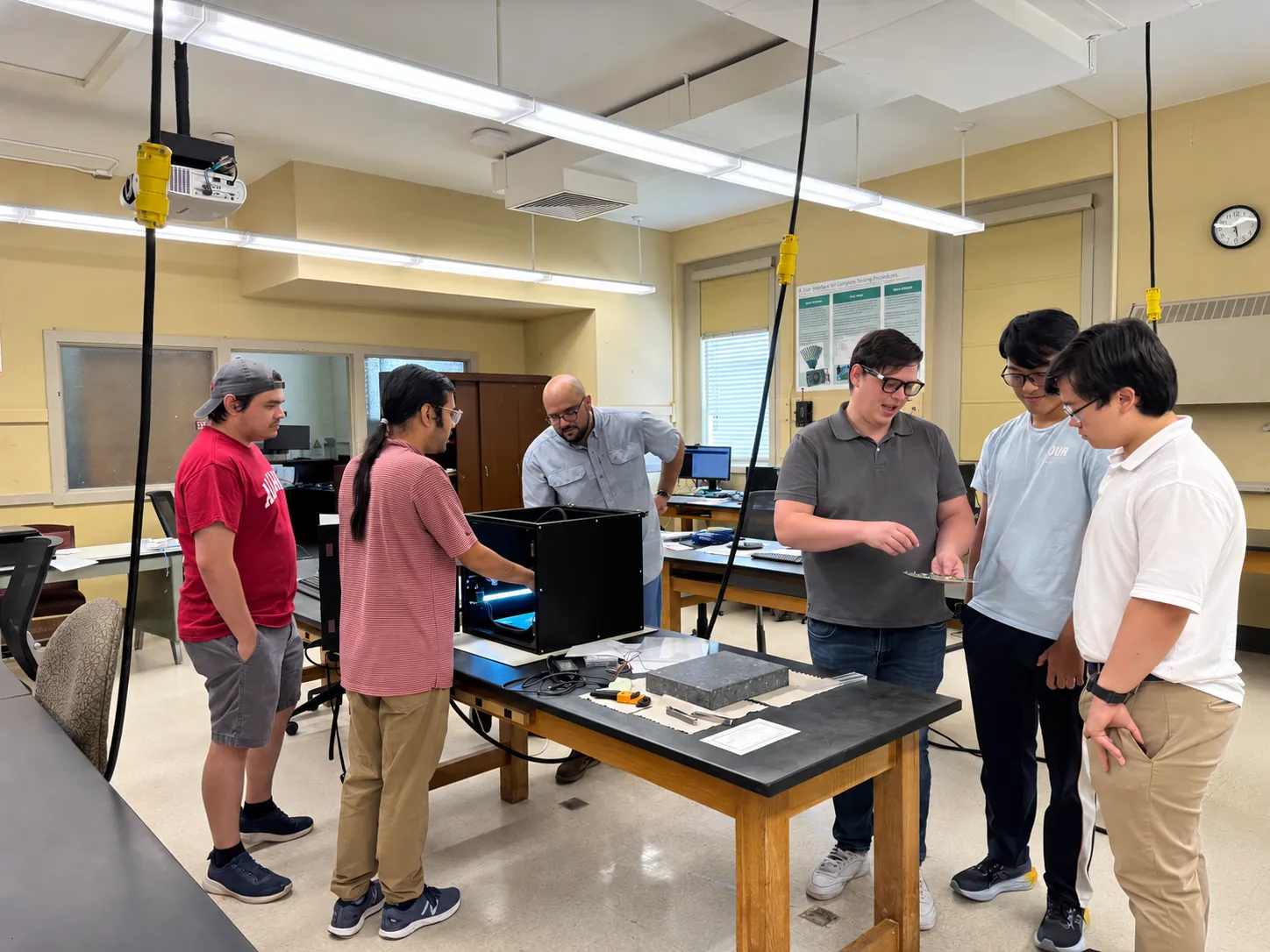
In our HGCAL lab you would check hexaboards, the hexagonal readout boards for a new part of the CMS detector, inspecting them under a microscope camera and running electrical tests on their readout chips.
 Emanuele UsaiParticle physics · UA
Join the lab
My group at The University of Alabama works on the CMS experiment at CERN’s Large Hadron Collider. We test hardware for the CMS detector upgrade, analyze LHC data, and build AI tools for particle physics. I’m recruiting graduate and undergraduate students.
ScrollFor students
Undergraduates
In our HGCAL lab you would check hexaboards, the hexagonal readout boards for a new part of the CMS detector, inspecting them under a microscope camera and running electrical tests on their readout chips.
Graduate students
Each graduate student in the group works on an analysis of CMS collision data, such as four-top production or a search for new heavy quarks, with tools that include machine learning and high-performance computing.
Why this group
How to join
It starts with an email. Here is what to send, depending on where you are now.
UA undergraduates
Email me at eusai@ua.edu with:
Prospective graduate students
Postdocs and collaborators
If you are interested in working together, email me your CV and a short description of your research interests.
My collaborations have also reached beyond experimental particle physics, into astrophysics, lattice gauge theory and genomics.
Interdisciplinary workResearch projects
My group works at both ends of a particle physics result: testing detector parts at the lab bench, and turning collision data into results published in journals.
Detector hardware
For the High-Luminosity LHC, CMS is replacing the calorimeters at both ends of its detector (the parts that measure particle energies) with the High Granularity Calorimeter (HGCAL). My lab, which I set up in 2024, performs quality control of its hexagonal readout boards, or hexaboards.
Skills you’ll learn
Data analysis
Our current analyses of CMS collision data:
Skills you’ll learn
Machine learning
We use machine learning to improve how particles are reconstructed and how collision events are identified in CMS data. This builds on my earlier work on end-to-end deep learning with a team at Google Research, in which neural networks learn to identify particles directly from low-level detector data.
Skills you’ll learn
Computing
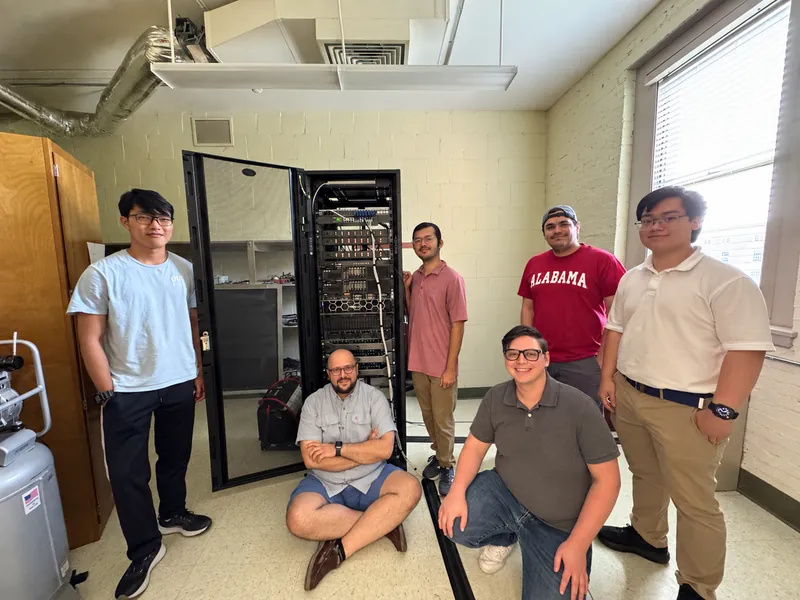
Analyzing LHC data and training neural networks take a lot of computing power. I set up a high-performance computing cluster at UA dedicated to CMS data analysis and machine learning, in service since May 2024. You would learn to run your analysis and training jobs on it and to work with large data sets.
Skills you’ll learn
People
Today the group has one postdoctoral researcher, three graduate students (I am their main advisor) and two undergraduate researchers.
Axel Perraguin
Postdoc · since Feb 2024
Construction of the CMS High Granularity Calorimeter, and a measurement of quantum entanglement in top quark–antiquark pairs that decay entirely into jets (the all-hadronic channel).
Guillermo Fidalgo
Graduate student · since Aug 2024
Four-top production in the single-lepton final state: collisions that leave one electron or muon.
Nathan Nguyen
Graduate student · since May 2026
Four-top production in the opposite-sign dilepton final state: two electrons or muons of opposite charge. Undergraduate researcher in the lab from 2024 to 2026.
Abhipsa Acharya
Graduate student · since May 2026
Search for pair-produced T′ quarks, hypothetical heavy partners of the top quark. Co-supervised research project in 2024–2025.
Chad Leino
Undergraduate · since 2024
Testing and inspection of HGCAL hexaboards.
Alejandro Jimenez Corella
Undergraduate · since 2026
Testing and inspection of HGCAL hexaboards.
Photos
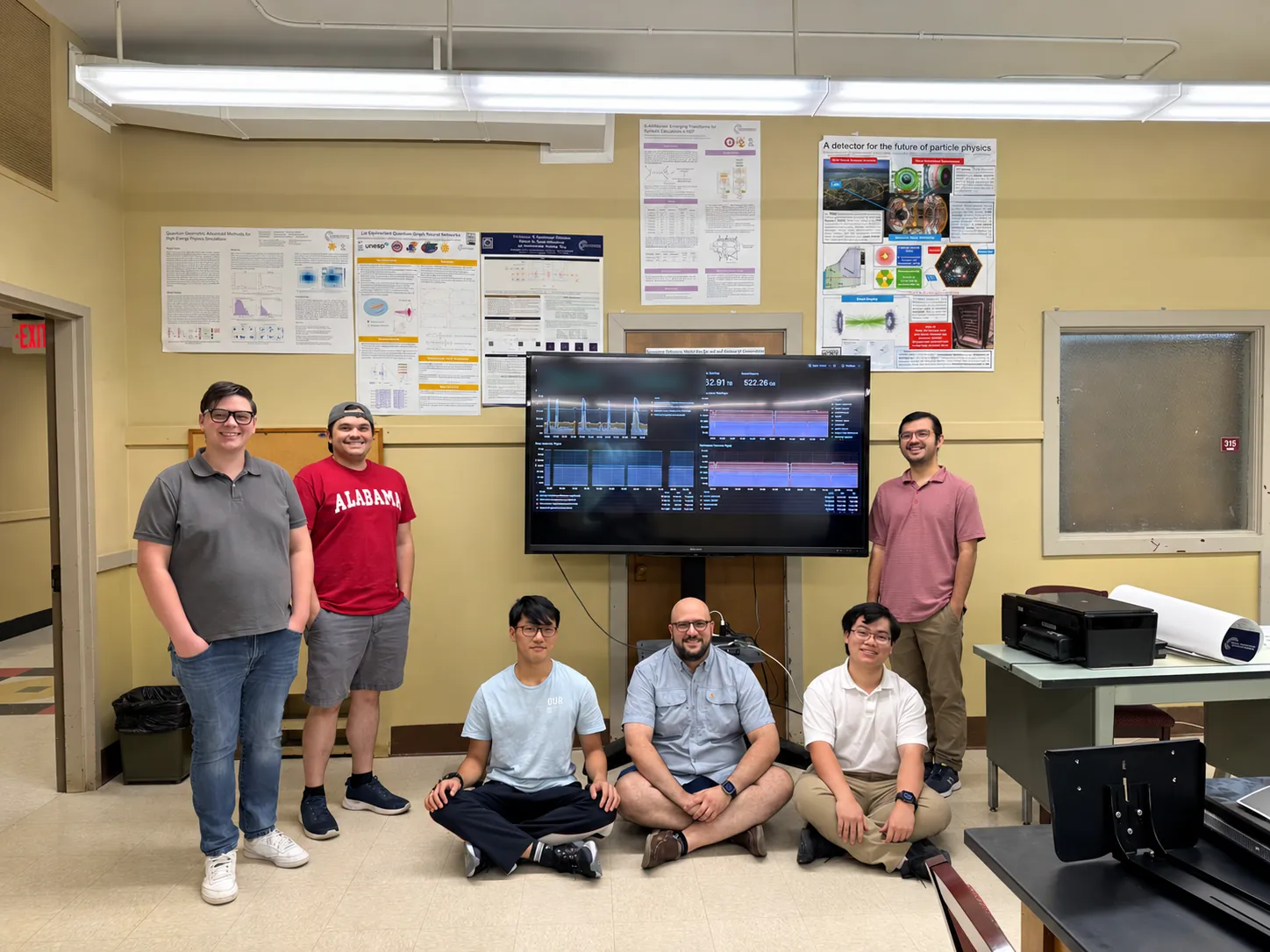
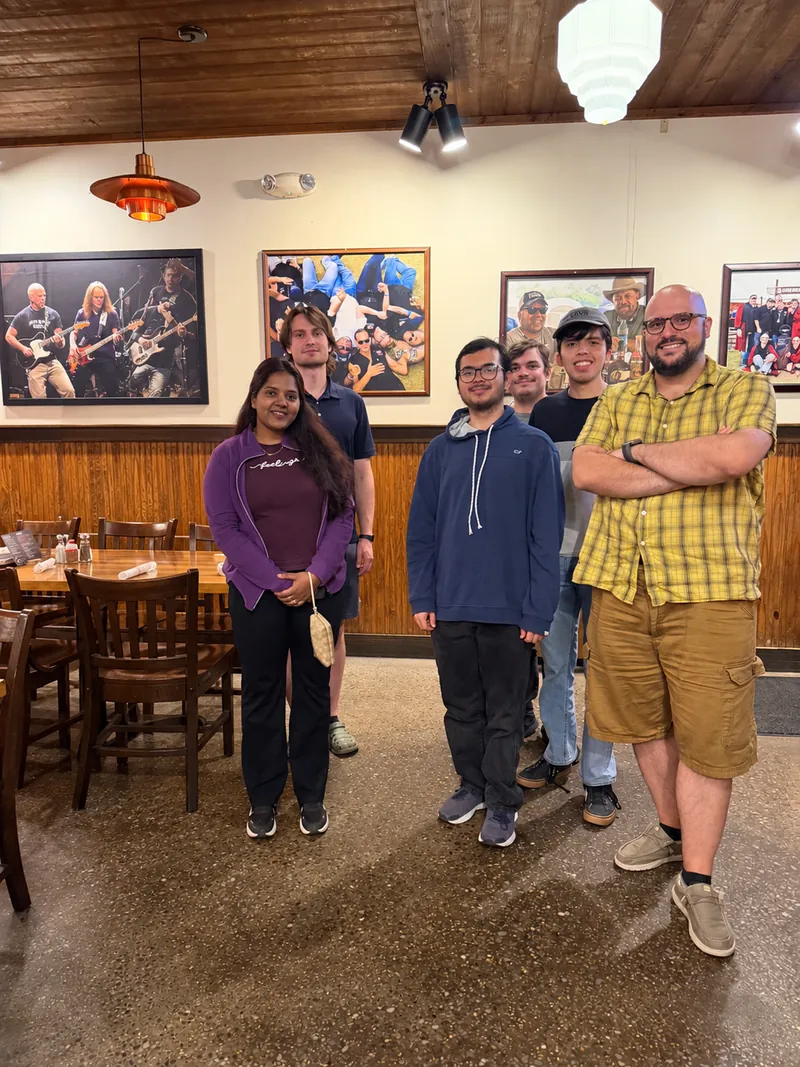
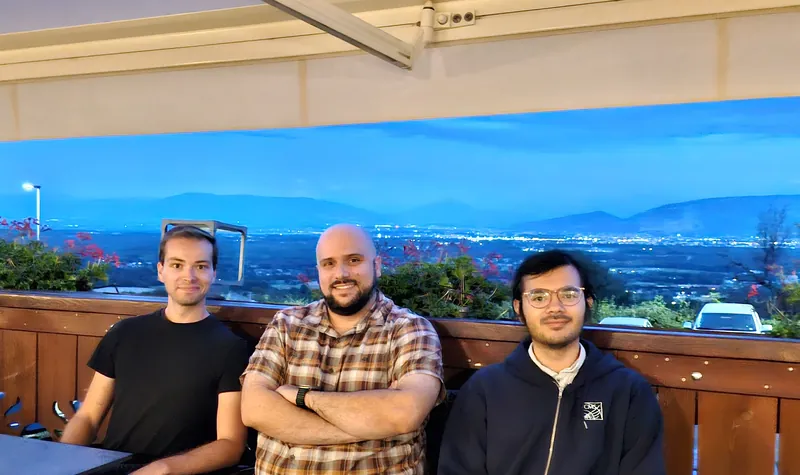
We work as a team, at the test bench and at the computing cluster, and we get together outside the lab too.
Tell me a little about yourself and what draws you to particle physics, and we can set up a time to talk. You can write to me at eusai@ua.edu. My office is 321-A Gallalee Hall, in the Department of Physics and Astronomy at The University of Alabama in Tuscaloosa.